There’s a quiet thing that happens when you walk into a Korean board game shop as a foreigner: you turn a corner and find a shelf of Pokémon games that simply do not exist where you came from.
Not “hard to find.” Not “out of print.” They were never published there at all.
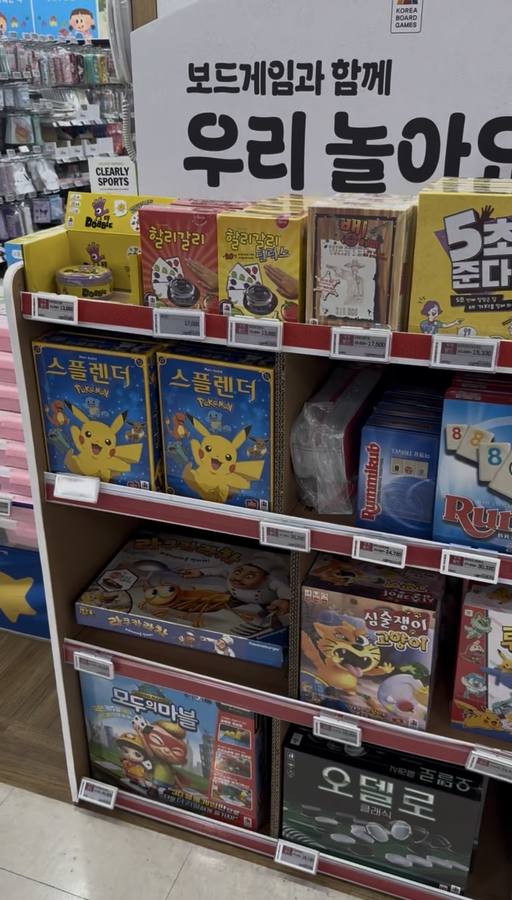
Pokémon licensing is carved up by region, and the deals that put Pikachu on a Korean box don’t travel. A Korean publisher can secure the rights to make a Pokémon version of an existing eurogame for the Korean market, and that’s where it stops. None of the five games below has an announced international release, and given how these agreements are structured, one is unlikely. If you want them, you come here. Or you pay import prices to someone who did.
Here are the five worth your suitcase space.
Splendor Pokémon
Splendor is Marc André’s 2014 engine-builder. Collect gem tokens, buy cards, and those cards act as permanent discounts that make the next purchase cheaper. Pure snowball.
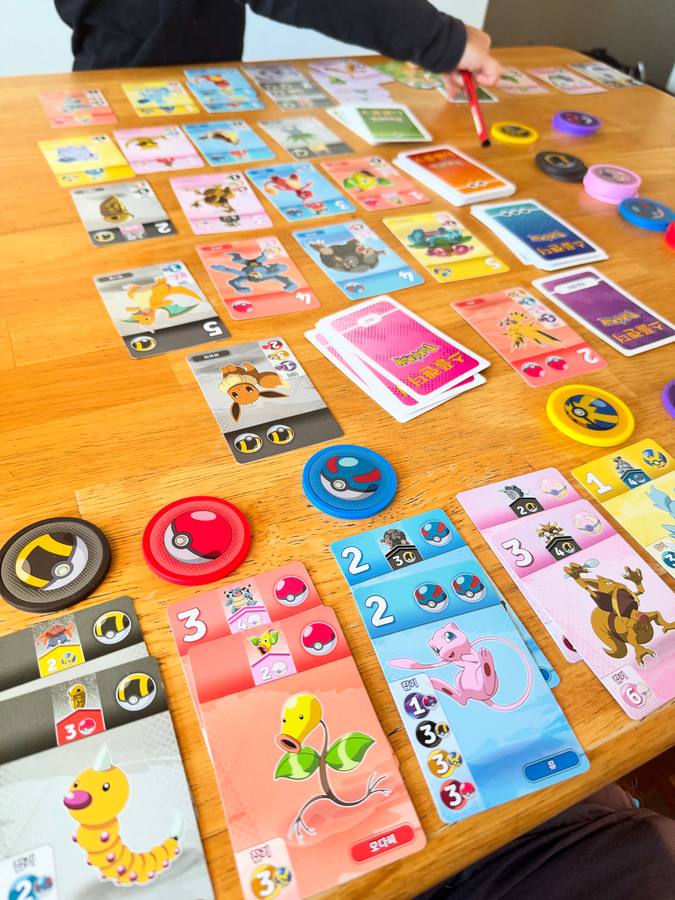
Korea Boardgames’ 2023 edition weaves in new mechanics rather than just re-skinning. Gems become Poké Balls, gold becomes a Master Ball. The noble tiles are gone, replaced by evolution: if the next-stage evolution of a Pokémon you own is on display and you can pay for it, you evolve it, gaining more points and another card in your collection. Two new decks sit alongside the standard ones, Rare and Legendary, with only one of each on display at a time. Catching them pays out two Poké Balls instead of one, and the Legendaries, the highest scorers, need Master Balls. The target is 18 points rather than 15.
None of this will change the mind of someone who dislikes Splendor, and none of it will put off someone who loves it. It’s the same game underneath. What it does is make an old favourite feel fresh again, and it’s a genuinely good doorway for people who’d never have picked up a euro engine-builder but will absolutely pick up a box with Charizard on it.
The best thing in the box isn’t a mechanic. It’s the little Pokédex you tick off as you catch things. In my house it has repeatedly made us play worse, passing up the efficient buy because someone wants to check off one more Pokémon. That’s not a design flaw. That’s the theme doing exactly what it’s supposed to do, and no other version of Splendor does it.
And every box comes with a randomly inserted foil card. A small thing, but the kind of small thing that makes opening the box feel like opening a pack.
Effectively none.
Paper Safari: Pikachu and Friends
Paper Safari is a Korean design by Kevin Kim, published by Mandoo Games. You get six cards face down in front of you and you don’t know what they are. On your turn you draw and swap, slowly working out and improving your own hand. Lowest total wins. You want the small numbers. Tarzan cards blow up other people’s carefully built rows; elephants help you.
Asmodee Korea’s 2022 edition brings 56 cards (four of each type), 12 Poké Ball tokens and a metal coin. Fifteen Kanto Pokémon (Pikachu, Eevee, Bulbasaur, Squirtle, Charizard, Snorlax, Gengar, Ditto, Jigglypuff, Slowpoke, Onix, Zapdos, Mew and friends) plus Team Rocket.
Six of them are special cards with their own abilities: Snorlax, Charizard, Zapdos, Mew, Ditto, and Team Rocket. The Team Rocket card and the metal coin are the one genuine rules difference. Neither exists in the original Paper Safari. When Team Rocket turns up, someone flips the coin (Pikachu on one face, Meowth on the other) and the round gets a little luckier. The Poké Ball tokens go to whoever wins each round.
It’s a small change, and it’s worth being honest that it probably isn’t the reason you’d pick this over the original. The two are close enough that the real decision is which art you’d rather look at: cute safari animals, or Gen 1 Pokémon. Nice to know the difference is there, but it isn’t the selling point.
None beyond the rulebook.
Pokémon Code Talk
Code Talk is an abstract strategy game, a hybrid of tic-tac-toe and ultimate tic-tac-toe. Simple enough to teach in under a minute, deep enough that you spend the whole game reading where your opponent is going and trying to block them. 2–4 players, 8+.
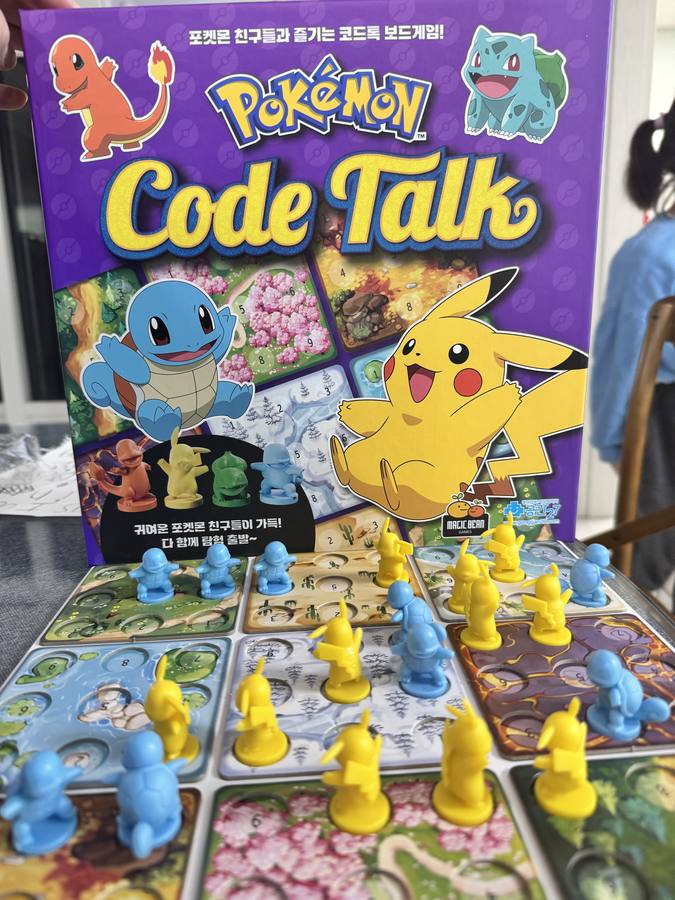
It’s a Pokémon limited edition of the abstract. The rules are the rules; the appeal is that you’re playing a genuinely sharp little abstract with Pokémon on the pieces.
None. It’s an abstract. There is literally nothing to read.
Point Salad: Eevee Edition
Point Salad is a two-sided drafting game. Every card is both a vegetable and a scoring condition, and you’re constantly deciding whether a card is worth more as a thing or as a rule. The scoring conditions are shuffled fresh every game, so no two plays value the same cards.
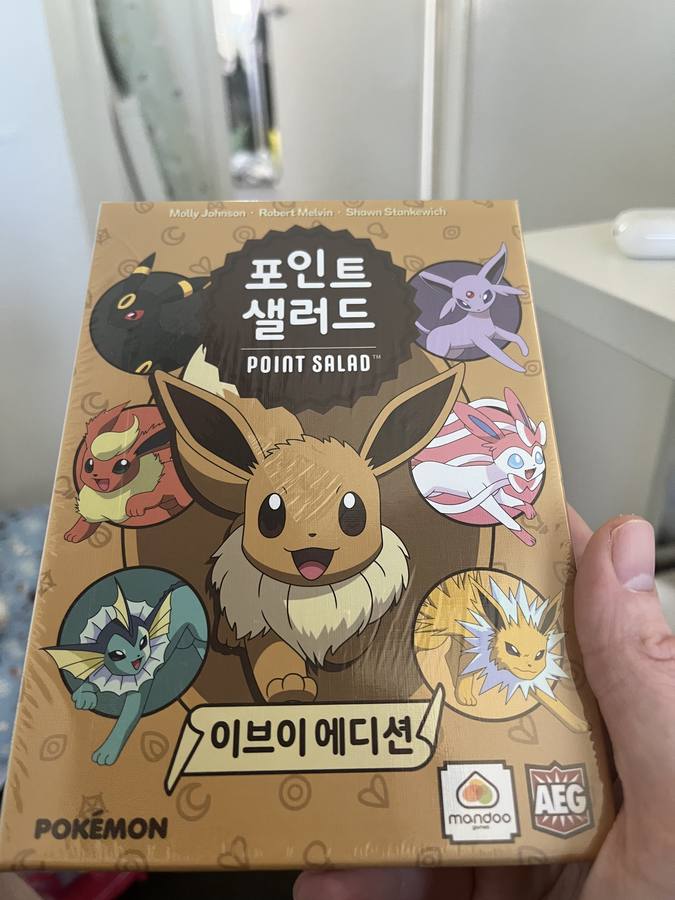
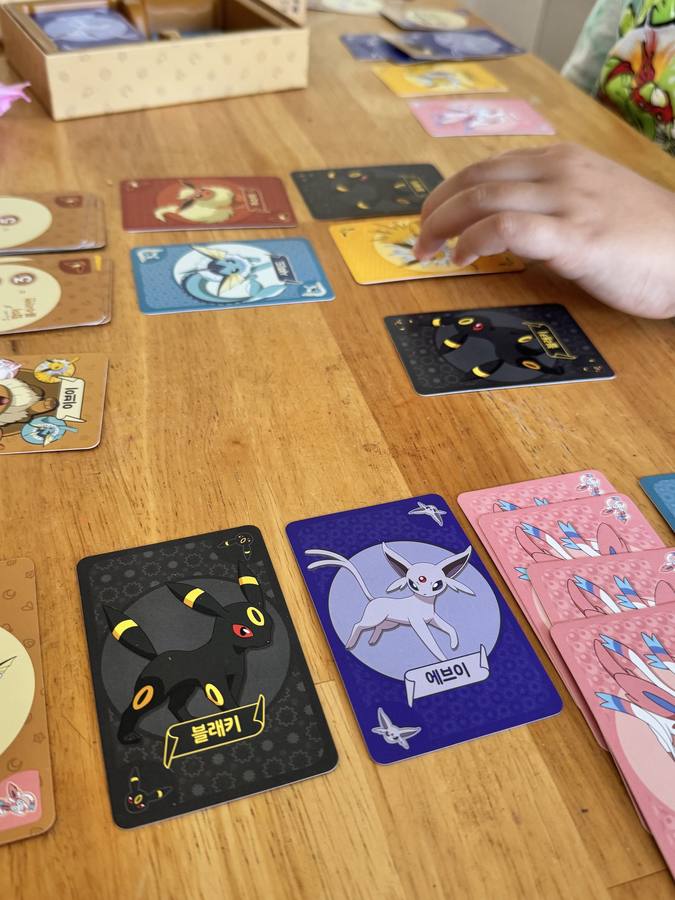
Asmodee Korea’s 2022 edition is built entirely around Eevee. The six vegetables become the six Eeveelutions, and Eevee itself, the Pokémon that can become anything, is folded in as a wild, with two joker cards added to the deck. About 110 cards. It’s a thematic fit so neat it feels like the original design was waiting for it.
Fair warning: this one sold out repeatedly on release and can be a hunt.
The only real one on this list. The scoring conditions are printed in Korean. That said, it’s a solved problem. Point your phone’s camera translator at a card and you’re fine, and there are community translations available, including the English card translation PDF on BoardGameGeek. Print it, tuck it in the box, done.
Ubongo Mini: Pokémon
Speed puzzle-solving. Flip a card, race to fit the polyomino tiles into the shape shown, slam down when you’re finished. Ubongo Mini strips out the gem-collecting board of the full game and keeps only the pure race.
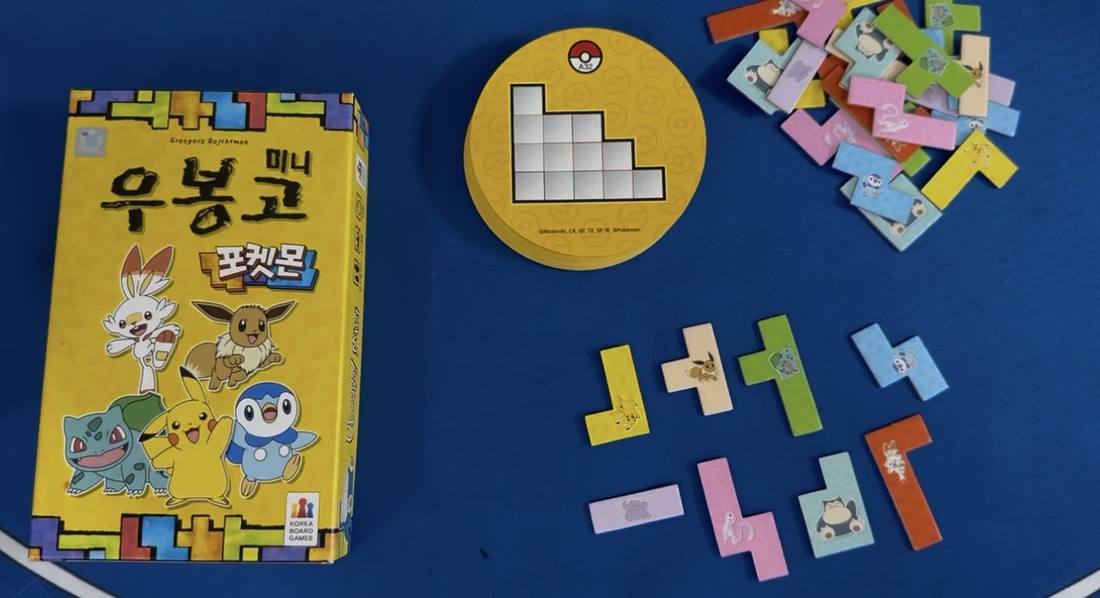
Korea Boardgames’ 2023 edition puts Pokémon on the tiles and cards. It’s 1+ players, 15 minutes, 7 and up.
None. It’s a shape puzzle.
So, Are These For You?
If you’re a Pokémon fan, you already know the answer. Some of you will pick these up for the skin alone. For the Gen 1 art, for the Pokédex you get to tick off, for the fact that this particular box exists nowhere else on the planet. That is a completely legitimate reason to buy a board game, and we’re not going to pretend otherwise.
But it’s worth saying that these aren’t only coats of paint. Splendor Pokémon weaves in evolution, Legendaries and a Pokédex checklist that will genuinely refresh a game you’d stopped pulling off the shelf, and it’s a doorway for people who’d never touch a euro but will happily play one with Charizard on it. Point Salad’s Eevee Edition fits its theme so cleanly that the Eevee wild card feels like something the original design was always missing. Even Paper Safari slips in a Team Rocket card and a coin flip the original never had.
None of these will convert someone who dislikes the underlying game. That’s not what they’re for. They’re for the people who already like it and want it to feel new again. And for the people who’ll try a board game because Pikachu is on the box.